
How to Search Union County Traffic Court Records
The main tool is the North Carolina eCourts Portal. It is free and open to the public. Union County moved onto the statewide Odyssey system in October 2024, so traffic citations now sit in the same database every county uses. The Portal lets you search by citation number, party name, case number, or county. Eligible citations can also be paid through the Portal. The Union County Judicial Branch page links both the Portal and the payment screen, so it is a good place to start if you are not sure which tool you need.
Before you begin, gather what you have. The citation number is the fastest way in. A full name and the correct county also work. If you only know the driver name, pick Union County so statewide results do not crowd the list. Keep the paper ticket nearby. It usually prints the citation number, the court date, and the charge.
- Open the eCourts Portal, or start from the Union County Judicial Branch page and follow the Portal or payment link.
- Enter the citation number, or type the driver name if you do not have the number.
- Select Union County in the county field to keep results local.
- Review the case details: charge, court date, plea, disposition, and any fine or costs.
- Pay an eligible citation online, appear to contest it, or ask the clerk for a certified copy of the file.
The help topic below comes from the Judicial Branch and explains how traffic violations are handled statewide. See the North Carolina traffic violations help page for the official overview.
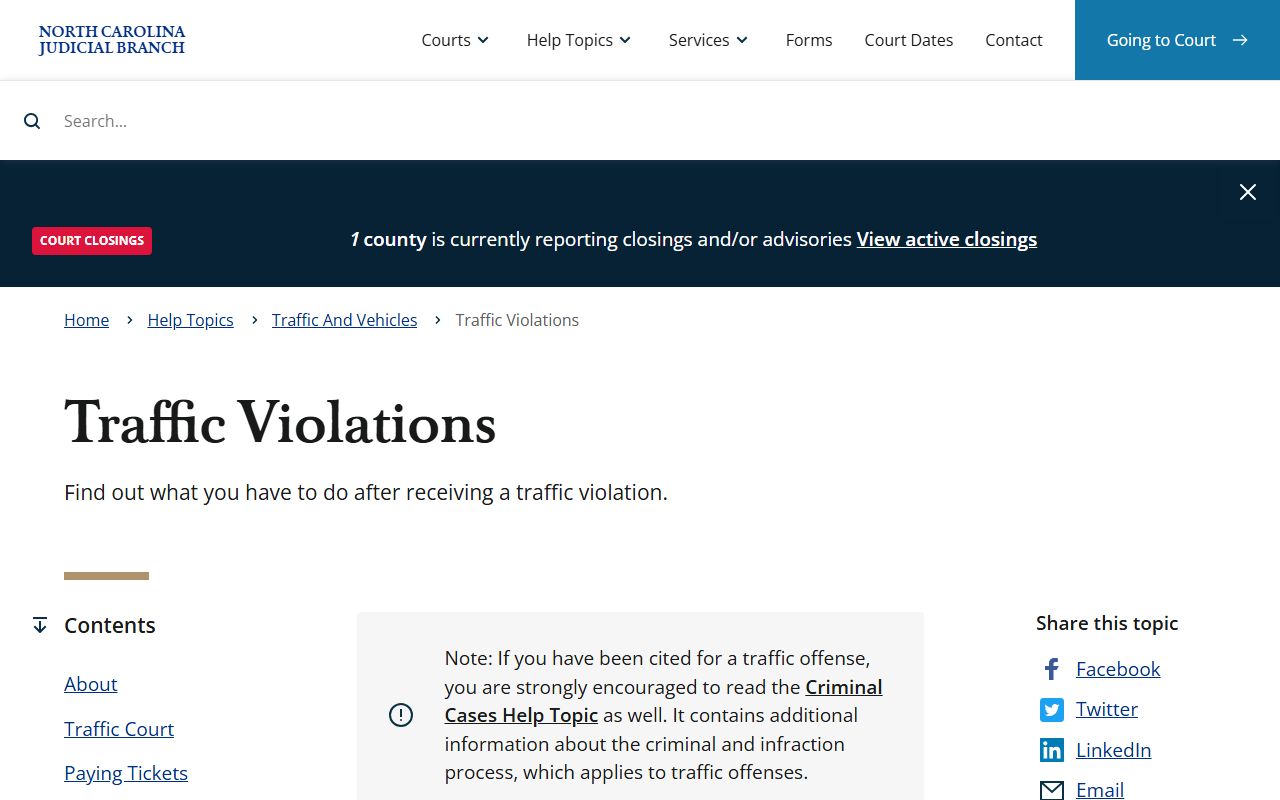
That page sets out which tickets can be paid, which need a court date, and what happens if you do nothing. Read it before you decide to pay or fight a Union County traffic citation.
Which Courts Handle Traffic Cases in Union County
Traffic cases in Union County run through North Carolina District Court for the most part. District Court hears infractions, traffic misdemeanors, and the citations officers write each day. It is the lower trial division of the General Court of Justice, and it sits in District 30 here. Most speeding tickets, stop-sign violations, and license charges land in this court. Magistrates also play a role at the front end, since they handle some initial process and waivable offenses.
Superior Court enters the picture only for the most serious matters or appeals. A felony death-by-vehicle case, for example, would move up. But a normal traffic ticket stays in District Court from start to finish. The table shows how the trial courts split traffic work in Union County.
| Court | Traffic Cases Handled | Location |
|---|---|---|
| District Court (District 30) | Infractions, traffic misdemeanors, citations, waivable offenses | Union County Judicial Center, Monroe |
| Magistrate | Initial process, some waivable citations, first appearances | Union County, Monroe |
| Superior Court (District 30) | Felony vehicle offenses, appeals from District Court | Union County Judicial Center, Monroe |
For a fuller look at how the trial level works, see the Union County District Court page, which also covers Superior Court.
Types of Traffic Cases on Record
Traffic court records cover a wide range. Some are minor infractions that you can pay and close. Others are crimes that can mean an arrest and a mandatory court date. The line between an infraction and a misdemeanor matters, because it changes how the case is handled and what shows up later. DWI is the clearest example of a traffic charge that becomes a full criminal case.
- Moving violations - speeding, running a light or sign, unsafe movement, and similar driving offenses.
- License and registration - driving while license revoked, no operator license, expired tag, or no insurance.
- Equipment violations - faulty lights, no inspection, or other vehicle-condition tickets.
- Commercial vehicle and CDL - violations tied to trucks, buses, and commercial license holders.
- Criminal traffic - DWI, reckless driving, and felony death by vehicle, which route to criminal handling.
Failure to appear is its own kind of event. Miss a court date and the file can show an order for arrest plus license consequences, even on a small ticket.
What Union County Traffic Court Records Show
A traffic record is built from set fields. Once you know them, a Portal result is easy to read. The court file tracks the charge, the court date, the plea, and the outcome. It also tracks money owed and any failure-to-appear or order-for-arrest events. The list below mirrors a standard public traffic case view for Union County. Sealed or restricted parts will not show.
| Field | What It Shows |
|---|---|
| Citation Number | The number printed on the ticket and used to find the case. |
| Charge / Statute | The traffic offense, statute cited, and whether it is an infraction or misdemeanor. |
| Court Date | The scheduled hearing or appearance date and the session. |
| Plea | The driver's response, such as guilty, not guilty, or responsible. |
| Disposition | How the case ended: paid, dismissed, found responsible, or convicted. |
| Fine and Costs | The fine amount plus court costs and any amount still due. |
Points are not assigned by the court file itself. The state assigns license and insurance points on the driver record after a conviction is reported, which is why the two records are kept apart. The Union County court records page breaks each field down in more detail.
Searching by Citation Number vs by Name
Both methods work in the Portal, but they fit different situations. The citation number is best when you hold the ticket. It points straight to one case and skips the guesswork. A name search is the fallback when the ticket is lost. The trade-off is that common names return many matches, so you may need a date or county to narrow the list. Always select Union County. A wrong county field is the most common reason a search comes back empty.
| Search Field | Type | Required | Notes / Format |
|---|---|---|---|
| Citation Number | Text | Optional / primary | Best field for tickets; enter the number exactly as printed. |
| Name | Text | Optional | Search the party or defendant name when the citation is unknown. |
| County | Dropdown | Recommended | Select Union County to keep results local. |
| Case Number | Text | Optional | Use if the citation became a court case file. |
| Search / Pay | Button | n/a | Finds the citation and opens eligible payments. |
Note: type the citation number exactly as it appears on the paper ticket, since an extra space or missing digit can hide the case.
Paying or Contesting a Union County Traffic Ticket
You usually have two paths. Pay the citation, or contest it in court. Eligible, waivable tickets can be paid through the Portal or the payment link on the Union County Judicial Branch page. Paying is treated as admitting the offense, so think it through first. Some charges are not waivable. Driving while license revoked, no insurance, and any criminal traffic charge often require a court appearance, and you cannot just pay them online.
To contest, do not pay. Paying closes the case against you. Appear on your scheduled date, or ask the court about your options before then. North Carolina District Court traffic sessions can be busy, so arrive early and bring your paperwork. The step list below tracks the basic flow.
- Locate the citation in the Portal by citation number, or by name and Union County.
- Check whether the offense is waivable or payable. If it is not, plan to appear or talk to a lawyer.
- To pay, follow the Portal payment steps and save your receipt.
- To contest, do not pay. Appear on the scheduled date or request the right relief from the court.
- If you miss court, check the file for a failure-to-appear, a license action, and any order for arrest.
- For driver record fixes, use NCDMV. Paying the court does not erase DMV consequences on its own.
Public Access Laws for Traffic Court Records
North Carolina law leans open. The state Public Records Act treats most government documents as public, and court files have their own access rules on top of that. Adult traffic court records are generally open to anyone unless a statute or court order closes a part of them. Clerk records stay open during regular office hours. The state administrative office is not the keeper of county case files, so a Union County records request goes to the local clerk, not the state.
Key Statutes:
N.C. G.S. § 132-1 - Defines public records broadly across state and county government.
N.C. G.S. § 7A-109 - Keeps clerk court records open during office hours except where the law prohibits it.
Court Traffic Records vs State Driver Records
This is the part people miss most. The court traffic record and the state driver record are two different files. The court file is the case: the charge, the court date, the plea, the outcome, and the money. The Clerk of Superior Court and the eCourts Portal keep it. The driver record is held by the North Carolina Division of Motor Vehicles. It shows license status, convictions reported to DMV, points, and suspensions. One does not automatically update the other. You may need to deal with both.
| Item | Court Traffic Record | NCDMV Driver Record |
|---|---|---|
| Custodian | Clerk of Superior Court / eCourts | NCDMV |
| What it shows | Citation, charge, court date, plea, disposition, fine, FTA events | License status, reported convictions, points, suspensions, driver history |
| Where to access | eCourts Portal by citation, name, or case | NCDMV driving record request |
| Certified copy | Clerk for the court file | NCDMV for the driver record |
| Common use | Court compliance and case status | Insurance, licensing, employment, driver history |
The image below is the NCDMV driving records page, the official source for the state driver file. See the NCDMV driving records page for request options.
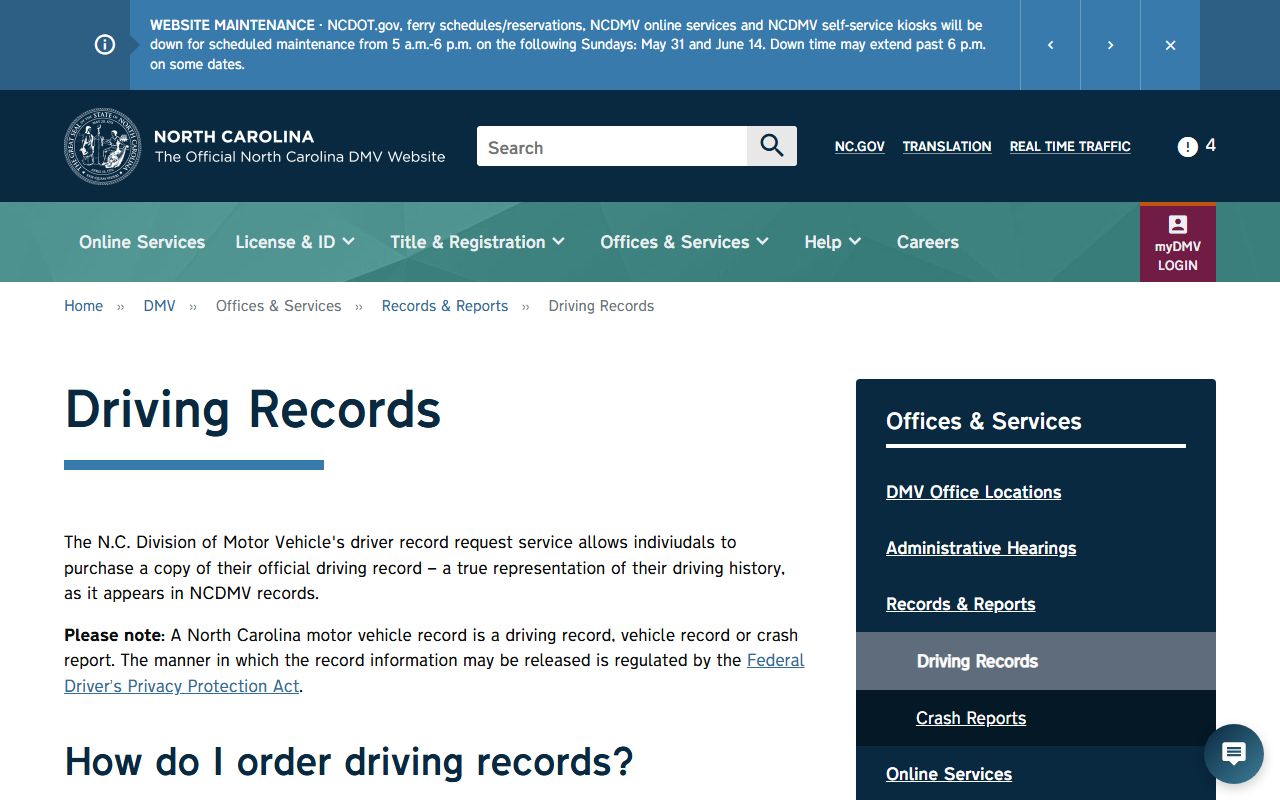
Use this page when you need the driver record for insurance or a job. For the case itself, you still go back to the court and the clerk.
CDL and Commercial Driver Records
Commercial drivers face stricter rules. A CDL holder usually cannot use the same options a regular driver can to keep a violation off the record. Federal rules require many commercial traffic convictions to be reported, even for tickets earned in a personal vehicle. That reporting can affect the CDL and a driver's job. Because the stakes are higher, commercial drivers often appear in court rather than simply pay a citation. The court file and the DMV record both matter here, so check both and talk to counsel if a CDL is on the line.
DUI / DWI Cases
DWI is not a simple traffic ticket. In North Carolina it is a criminal charge. It can mean an arrest, a bond, a mandatory court date, and DMV action against the license. These cases run through the criminal side of District Court, not the waivable-ticket process, so you cannot pay them online to close them.
For full Union County DWI and DUI case information, see Union County criminal records.
Deferred Adjudication and Defensive Driving
Drivers sometimes ask about deferral or a driving course to soften a ticket. Options like a prayer for judgment or a reduced charge are handled case by case in District Court, often through the district attorney or the court at the hearing. There is no automatic program that wipes a citation. What is offered depends on the charge, the driving history, and local practice. The safest move is to appear, ask about your options, and confirm in writing how any deal affects both the court file and the DMV record. A court outcome and a driver record point reduction are not the same thing.
Sealing or Expunging Traffic Records
Most plain infractions are not crimes, so the expunction statutes that clear criminal records do not always apply the same way. Criminal traffic charges are different. A dismissed or not-guilty DWI or other criminal traffic charge may be eligible for expunction under the state expunction laws. The petition is filed with the Clerk of Superior Court in the county where the case was charged, which means Union County cases go to the Union County clerk. Eligibility turns on the outcome, the offense, and any waiting period. The general expunction filing fee is $175, though many dismissed and not-guilty matters carry no fee.
Fees for Traffic Record Copies
Fees depend on what you ask for and who keeps the record. A certified single-county criminal record search runs through the Clerk of Superior Court with Form AOC-CR-314. The state driver record comes from NCDMV at its own rate. The table lists the figures confirmed by official Union County and Judicial Branch pages. Some plain-copy and traffic-specific search amounts were not published, so confirm those with the clerk before you pay.
| Item | Amount |
|---|---|
| Certified single-county criminal record search (AOC-CR-314) | $25 |
| General expunction filing fee | $175 (many dismissed or juvenile types are free) |
| Plain copy per page (clerk) | Confirm with the Clerk of Superior Court |
| State driver record (NCDMV) | See the NCDMV fee schedule |
Note: mailed payments for the criminal record search must be money order or certified check, while in person the clerk also takes credit card, cash, money order, or certified check.