
Getting a Marriage License in Union County
The Union County Register of Deeds issues marriage licenses. The office sits in the Union County Government Center at 500 North Main Street, Suite 258, in Monroe. Crystal D. Gilliard serves as Register of Deeds. Licenses are issued Monday through Friday, 8:30 a.m. to 4:00 p.m. Both applicants must come into the office at the same time to finish the application. One person cannot apply alone. This is a hard rule, not a suggestion, so plan for both people to be there together.
North Carolina marriage license rules are set by state statute. N.C. G.S. § 51-8 governs how the Register of Deeds issues a license. A license issued in North Carolina is for a ceremony performed in North Carolina only. The couple cannot use a Union County license for a wedding in another state. If the license expires before the ceremony takes place, the couple must apply for a new one. There is no carry-over.
Applicants can fill out the paperwork ahead of time. The Register of Deeds links an online marriage license application, or you can complete the forms in person at the counter. Filling it out online first can save time at the window. Even so, both people still have to appear together to sign and finish.
How to Apply for a Marriage License
The process moves fast when both applicants are ready. Bring identification and any documents the office asks for. Below are the steps in order. Follow them and the trip to the counter stays short.
- Confirm the couple meets North Carolina marriage requirements before you start.
- Fill out the application online through the Register of Deeds portal, or do it in person at the office.
- Both applicants appear together at 500 North Main Street, Suite 258, during issuing hours.
- Present identification and the completed application to the clerk.
- Pay the marriage license fee at the counter.
- Take the issued license and use it for a ceremony held in North Carolina.
The screenshot below comes from the Union County online marriage license application, the official starting point for the paperwork.
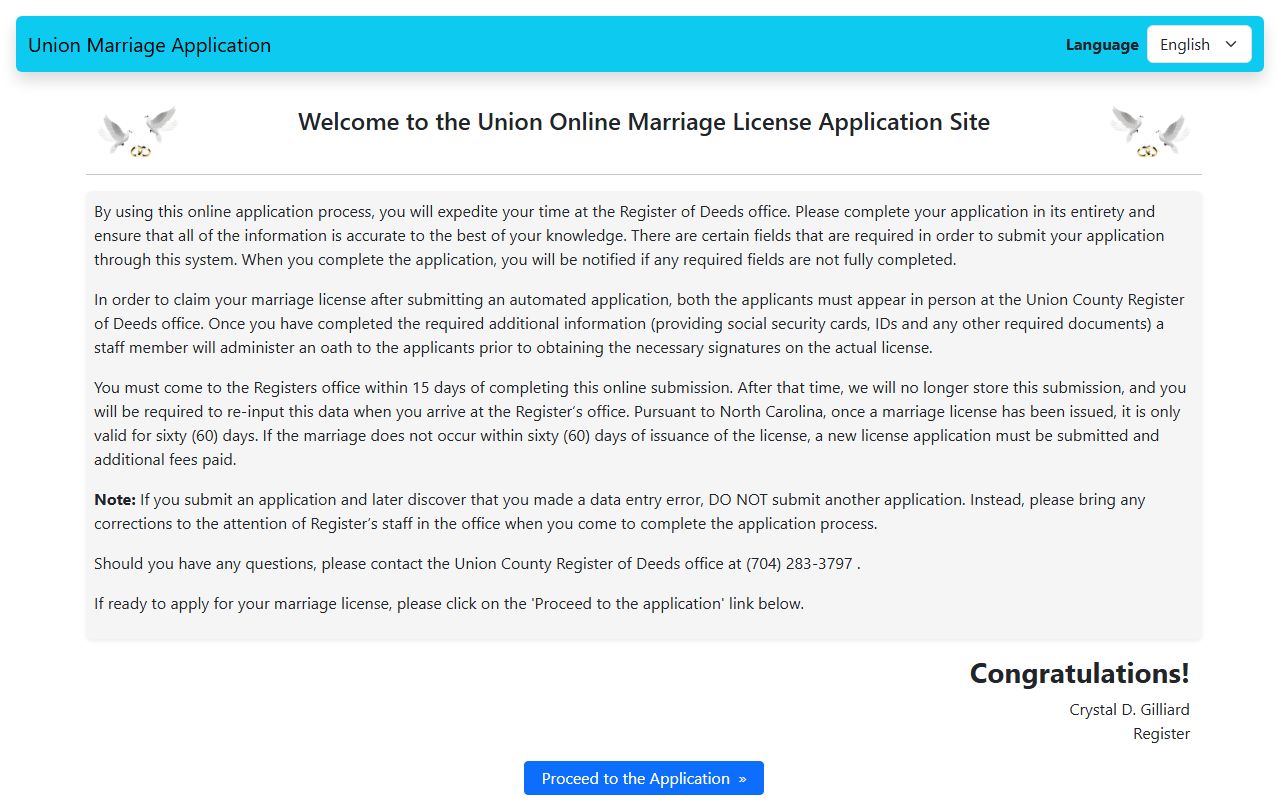
Starting the application here lets you key in the data at home, then the office only verifies and issues. It does not remove the in-person step, but it cuts the wait.
Union County Marriage License Application Fields
The online application collects information from both people. Some labels need a live walkthrough of the portal to read exactly, but the field groups are clear. The table below maps what the form asks for. State marriage licensing rules drive most of these fields.
| Field | Required | Notes |
|---|---|---|
| Applicant 1 information | Yes | Name, demographic, contact, and identity fields for the first applicant. |
| Applicant 2 information | Yes | Same set of fields for the second applicant. |
| Marriage details | Yes | Intended ceremony or location details may be requested. |
| Identification / Social Security fields | Yes / conditional | Required by state marriage licensing rules; verify exact labels at the portal. |
| Submit / completion | Yes | Both applicants still must appear in person together to finish. |
Note: filling out the online form does not issue the license; both people must still sign in person at the Register of Deeds office.
Magistrate Weddings in Union County
A magistrate can perform the ceremony itself. In Union County, magistrate weddings are by appointment only. They are held Monday, Tuesday, Thursday, and Friday at 10:00 a.m., 11:00 a.m., 3:00 p.m., and 5:00 p.m. The location is the Union County Magistrates Office at 3344 Presson Road, Monroe, NC 28112. This is a different building from the courthouse and the Register of Deeds, so do not mix them up.
You still need a valid marriage license first. The magistrate cannot marry a couple without one. Appointments must be booked online through the official scheduling link on the Union County Judicial Branch page. Walk-ins are not the norm here. Get the license from the Register of Deeds, then set the wedding time with the magistrate.
Union County Marriage and Divorce Fees
Fees split along the same line the records do. The Register of Deeds charges for marriage certificate copies. Divorce filing costs run through the court clerk and are set by state court-cost statutes. The table below shows the copy fees the Register of Deeds confirms.
| Item | Amount |
|---|---|
| Certified marriage certificate copy | $10 each |
| Uncertified marriage copy | $1 each |
| Certified birth or death copy | $10 each |
| Marriage license fee | Set by the Register of Deeds; confirm current amount with the office |
The Register of Deeds takes money orders, cash, and credit card for vital record copies. The marriage-license fee amount was not published in the office text reviewed, so call ahead or check the office fee schedule before you go. Divorce filing fees and certified divorce copy costs come from the Clerk of Superior Court, not the Register of Deeds.
Note: Certified copies are restricted by state law to listed family and authorized parties, while anyone may request an uncertified public copy.
How to Look Up Union County Marriage Records
Marriage records are vital records, not court files. To find a Union County marriage record, you go to the Register of Deeds, not the court clerk and not the eCourts Portal. The office keeps marriage license and certificate records for the county. You can request a copy in person or ask the office about mail and other request methods.
What you need is simple. Have the full names of both spouses. The date of the marriage helps the staff find the file faster. Decide up front whether you want a certified copy or an uncertified one, because the rules differ. A certified copy carries the official seal and is restricted under N.C. G.S. § 130A-93 to the people the statute lists. An uncertified copy is open to anyone who asks.
The image below is the North Carolina Judicial Branch divorce and marriage help topic, a useful state guide to both record types.
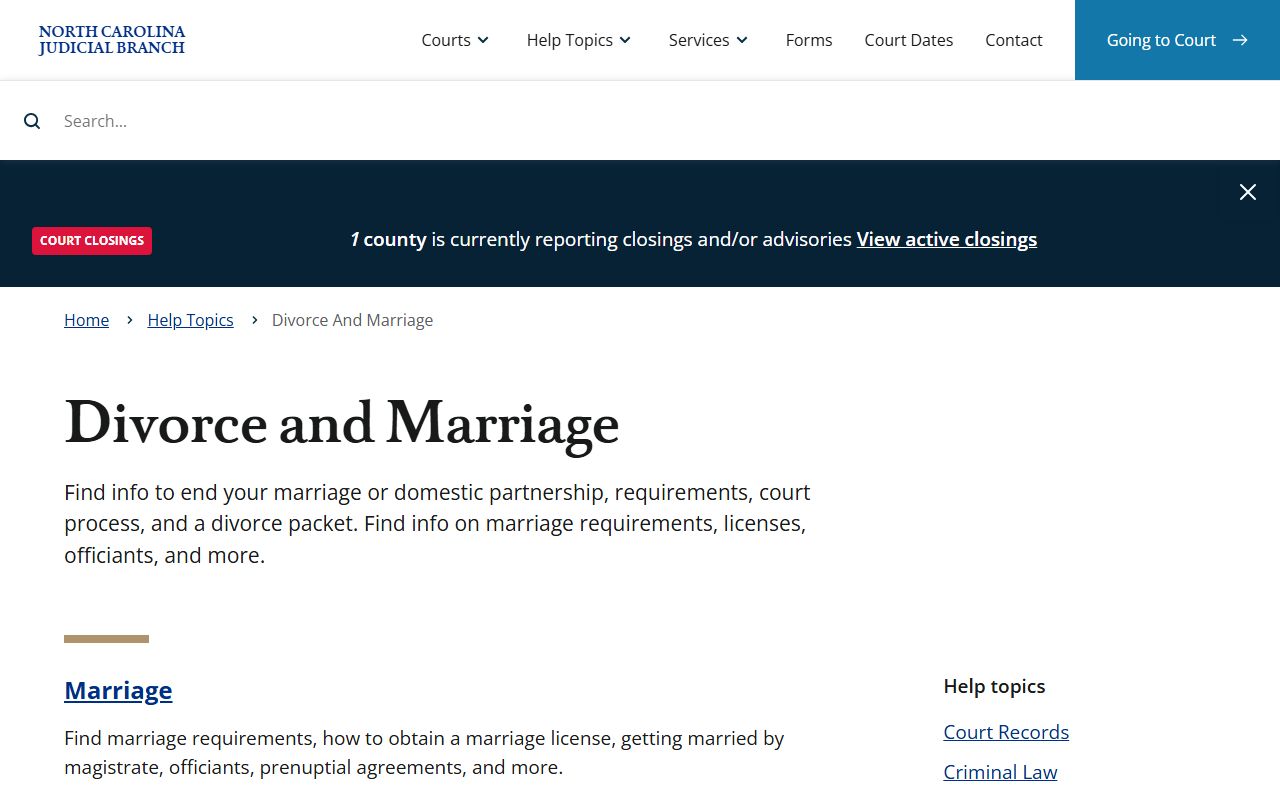
That page explains the marriage and divorce side together, which makes it a good first stop before you decide which office to contact.
How to Find Union County Divorce Records
Divorce is handled in court. In North Carolina, a divorce case is filed with the Clerk of Superior Court, and the file lives with the court, not the Register of Deeds. For Union County, that means the clerk at the Union County Judicial Center on North Main Street in Monroe. To search a divorce case, use the North Carolina eCourts Portal and pick Union County in the county field. The Portal is free and public.
The grounds and process for divorce sit in state law. N.C. G.S. § 50-8 sets out what a divorce complaint must contain. North Carolina allows absolute divorce generally after one year of separation, along with residency rules. A divorce file can include the complaint, the judgment, and orders on custody, support, and property. Some parts of a family file are sensitive and may be sealed or redacted, so not everything shows in a public search.
To file for divorce, the basic path looks like this.
- Confirm you meet the residency and one-year separation requirements under North Carolina law.
- Use the Judicial Branch divorce forms or talk with an attorney.
- File the complaint with the Clerk of Superior Court for the proper county.
- Pay the filing fee or ask for a fee waiver if you qualify.
- Serve the other party as the rules require.
- Calendar the case and obtain the judgment.
Certified divorce judgments and copies are requested from the clerk, not from the Register of Deeds.
Getting Certified Copies
A certified copy is the official version with a seal. Courts, agencies, and many legal filings will only accept a certified copy, not a printout from an online search. For a marriage certificate, the certified copy comes from the Register of Deeds at $10 each. For a divorce judgment, the certified copy comes from the Clerk of Superior Court.
Access to certified vital records is limited by statute. G.S. 130A-93 spells out who may get a certified birth, death, or marriage copy. Authorized people include the named parties and certain family members. An uncertified copy, at $1 each, can go to any member of the public. Bring identification and be ready to pay by money order, cash, or credit card.
Restricted Family Records
Some family records never show up in a public search. Adoption files are restricted by state law and do not appear in an ordinary Portal search. Juvenile matters are confidential. Personal identifiers like Social Security numbers, financial account numbers, and minor children's full data are redacted even on otherwise public files. Mental health and abuse or neglect files are also closed.
If a family file is sealed, you usually must be an authorized party or get a court order to view it. The request goes to the Clerk of Superior Court in the county where the case was filed, so Union County cases go to the Union County clerk. The state public-records framework leans toward openness under G.S. 132-1, but family and vital records carry their own limits on top of that.
Marriage and Divorce Statutes
A few state laws control how these records work. They are worth knowing before you apply or search. The screenshot below shows N.C. G.S. § 51-8 on the General Assembly site, the statute behind marriage license issuance.
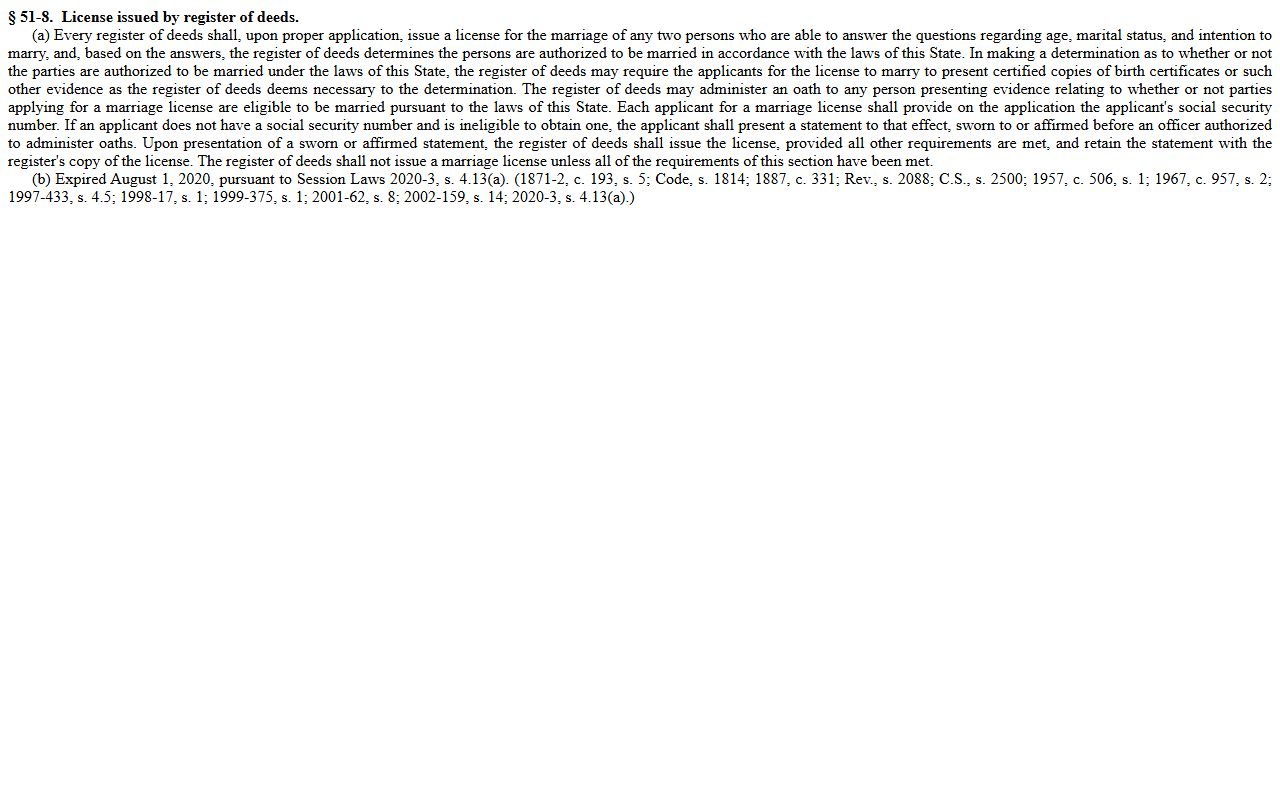
The marriage license statute pairs with the divorce and vital records laws to set the full framework.
Key Statutes:
G.S. 51-8 - Marriage license issuance by the Register of Deeds.
G.S. 50-8 - What a divorce complaint must contain.
G.S. 130A-93 - Who may receive certified vital records copies.