
Arrest Records in Union County
Arrest records start with law enforcement, not the court. When a deputy or officer arrests someone, that person is taken to the county detention center, searched, photographed, and booked. The Union County Sheriff's Office runs the jail and posts public arrest data online through its Superion P2C system. Sheriff Eddie Cathey was sworn in on December 1, 2002 and was later recognized as the county's first six-term elected sheriff. The office is one of the largest full-service law enforcement agencies in the state. Its public pages cover recent arrests, a daily bulletin, and a live inmate roster.
An arrest record is different from a criminal court record. The arrest record comes from the sheriff or a local police agency. It shows the booking event, the charge a person was arrested for, and the date. A criminal court record starts later, once the State files formal charges in court. That court file holds pleas, motions, and the final outcome. Full case history lives with the Clerk of Superior Court and is covered on the Union County court records page. Arrest data alone never tells you how a case ended.
How to Search Union County Arrest Records
The fastest path for recent bookings is the Sheriff's P2C system. Three pages matter here. The recent arrests page shows people booked lately with race, sex, and age filters. The daily bulletin lists arrests, citations, incidents, and ordinance events for a chosen date. The inmate inquiry shows who is currently held. Each page is free and open to the public. None of them is a certified record, so treat them as a starting point, not proof.
- Open the Sheriff's recent arrests page to scan the latest bookings, or pick a date on the daily bulletin.
- Use the filters on the recent arrests page for race, sex, or age to narrow a long list.
- Read the result row for name, primary charge, arrest date, and booking agency.
- Open the details link, where shown, for more on the booking and any photo the system displays.
The daily bulletin uses short case-number prefixes that tell you the event type fast. AR marks an arrest. TC marks a citation or summons. LW marks an incident. OR marks an ordinance violation. For a certified criminal history, though, the sheriff pages are not enough. That comes from the Clerk of Superior Court, explained further down.
Finding Recent Arrests and Bookings
The recent arrests page is built for exactly this task. It posts new bookings with a short demographic summary and the leading charge. The page carries an official notice that people shown have been arrested but not convicted at the time of posting. That line matters. An arrest is an accusation, and many cases end in dismissal or a not-guilty finding.
For people still in custody, the inmate roster is the better tool. It lists current detainees with name, primary charge, arrest date, and booking agency. To search by name or read what a roster result shows field by field, see the Union County inmate records page, which breaks down the roster in detail.
Note: The recent arrests page shows people booked but not yet tried, so a listing there is not proof of any conviction or guilt.
Mugshots and Booking Photos
A booking photo, or mugshot, is taken during the intake process at the jail. The Sheriff's P2C roster may show a photo in a detail view where one is available, though the public roster table itself does not always display it. Booking photos tie to the arrest event, not to any verdict.
Be careful with mugshot sites. Many private pages repost old booking photos and never update them when a charge is dropped. That can make a resolved or dismissed case look active for years. The official sheriff pages are the better source because they reflect current jail data. If a charge was later dismissed or expunged, an old third-party photo can be misleading and out of date.
Arrest Records vs. Criminal Court Records
People often blur these two. An arrest record is made at booking by the sheriff. A criminal court record is made when the State files charges and a case opens in court. They overlap but are kept by different offices and answer different questions.
| Arrest Record | Criminal Court Record | |
|---|---|---|
| Source | Union County Sheriff or local police | Clerk of Superior Court |
| Created When | At booking, right after arrest | When charges are filed in court |
| Contents | Booking info, charge, arrest date, photo where shown | Pleadings, motions, hearings, disposition, judgment |
| Where to Look | Sheriff P2C roster, bulletin, arrests page | eCourts Portal and the Clerk |
For the full life of a case, from first appearance to judgment, use the court file. The court records page walks through the eCourts Portal and the fields a case record shows.
Charges vs. Convictions
A charge is not a conviction. A charge is what the State says a person did. A conviction is a guilty plea or a finding of guilt that the court enters. The gap between them is large, and the standard of proof is very different.
| Charge | Conviction | |
|---|---|---|
| Stage | Accusation at or after arrest | Verdict or guilty plea |
| Burden of Proof | Probable cause | Beyond a reasonable doubt |
| Public Record | Yes, unless restricted | Yes, unless expunged |
| Outcome | May be dismissed or reduced | Sentence, probation, or fine may follow |
Read the disposition line on a court record to learn the real result. A dismissal means the case ended without a conviction. A dismissal with prejudice cannot be refiled. Without prejudice means it can come back. Many people see a charge on an arrest page and assume guilt, which is wrong.
Certified Criminal Records and Background Checks
For an official record, the arrest pages will not do. North Carolina handles a certified single-county criminal record search through the Clerk of Superior Court. The requester fills out and prints Form AOC-CR-314, then submits it to the Union County clerk with the fee. The Judicial Branch criminal background check guidance explains the process and what the search covers.
| Item | Detail |
|---|---|
| Form | AOC-CR-314, certified single-county search |
| Fee | $25 |
| Mail payment | Money order or certified check only |
| In-person payment | Credit card, cash, money order, or certified check |
A non-certified search can be done for free at public access computers in any courthouse, though printing may cost a little. The Judicial Branch notes that the eCourts Portal is useful for case details but is not the preferred way to run a background check. Use the clerk's office for a certified result. Form AOC-CR-314 is found in the statewide forms library.
Important: This is a privately operated site and is not a consumer reporting agency under the FCRA, so its data may not be used for employment, credit, or tenant decisions.
Statewide Criminal Record Context
A single-county search only covers Union County. Someone could have records in other counties or in the state and federal systems. The certified AOC-CR-314 search is county-specific by design. For sentenced state offenders, the North Carolina Department of Adult Correction runs a public offender search that shows custody status and conviction data. For federal cases, the Bureau of Prisons keeps a separate locator.
These tools answer different questions than a local arrest page. The sheriff roster shows current local custody. The state and federal tools show people serving longer sentences elsewhere. The released inmates page links the state and federal search tools and explains how each one works.
The Union County Sheriff Crime Laboratory
One local detail sets Union County apart. The Sheriff's Office operates its own crime laboratory, which is more developed than many county labs. The lab page says it is supervised by Director Dr. Lindsey Falzone and offers crime scene work, digital forensics, latent print analysis, chemistry and toxicology, seized-drug testing, and evidence services.
The lab holds ISO/IEC 17025 accreditation, with accredited disciplines in friction ridge analysis, seized drug testing, and antemortem toxicology. It is also expanding toward Rapid DNA capability. This matters for criminal records because lab results feed the charges and evidence that show up later in a court file. Forensic findings can shape whether a charge is upgraded, reduced, or dropped before trial.
Restricted Criminal Records in Union County
Not every record is open. Some are closed to protect children, victims, or people whose cases ended in their favor. Juvenile delinquency records are confidential under state law, even though many juvenile hearings are open. Adoption files, mental health commitments, and abuse or neglect files are restricted. Sealed and expunged records will not appear in a normal search.
The Judicial Branch explains juvenile confidentiality in its family-and-children help topic. The image below comes from the juvenile delinquency help topic page.
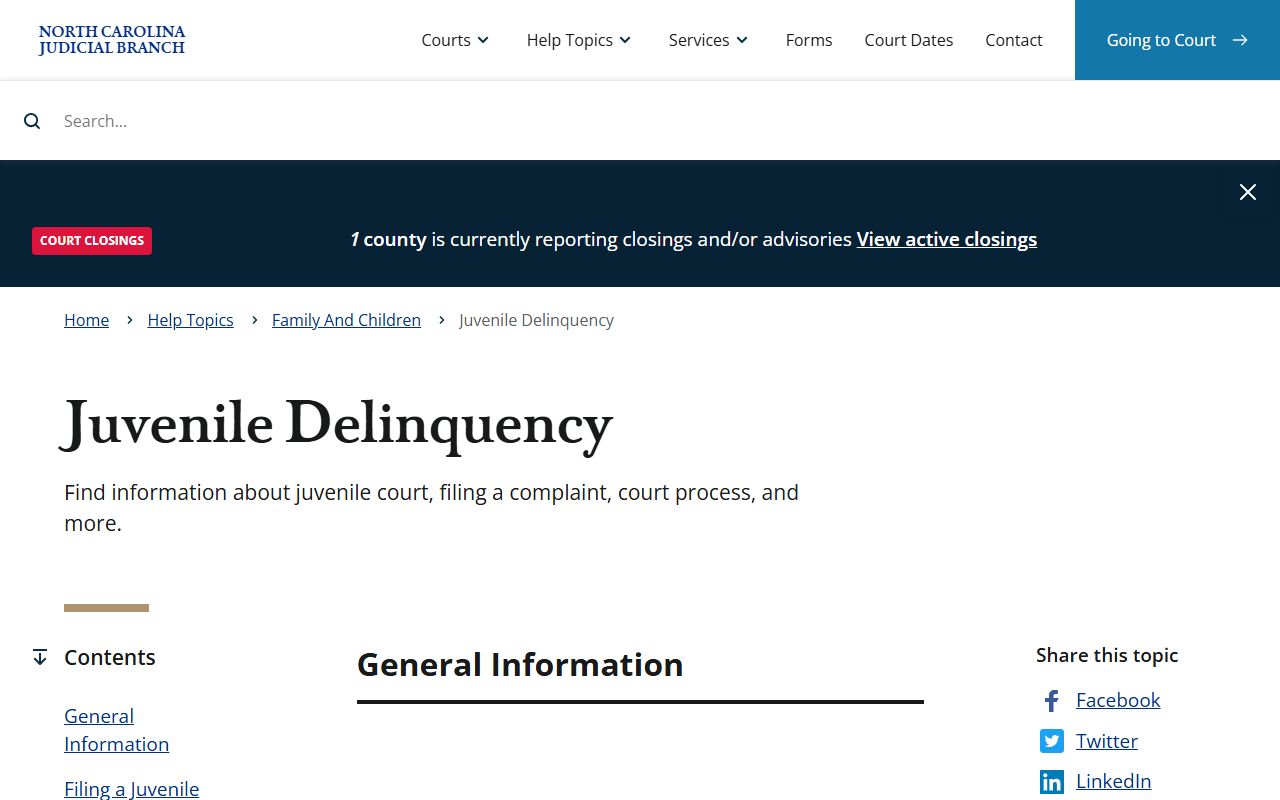
That page confirms juvenile court records are withheld from public inspection. The governing statute is shown below, captured from G.S. 7B-3000 on the General Assembly site.
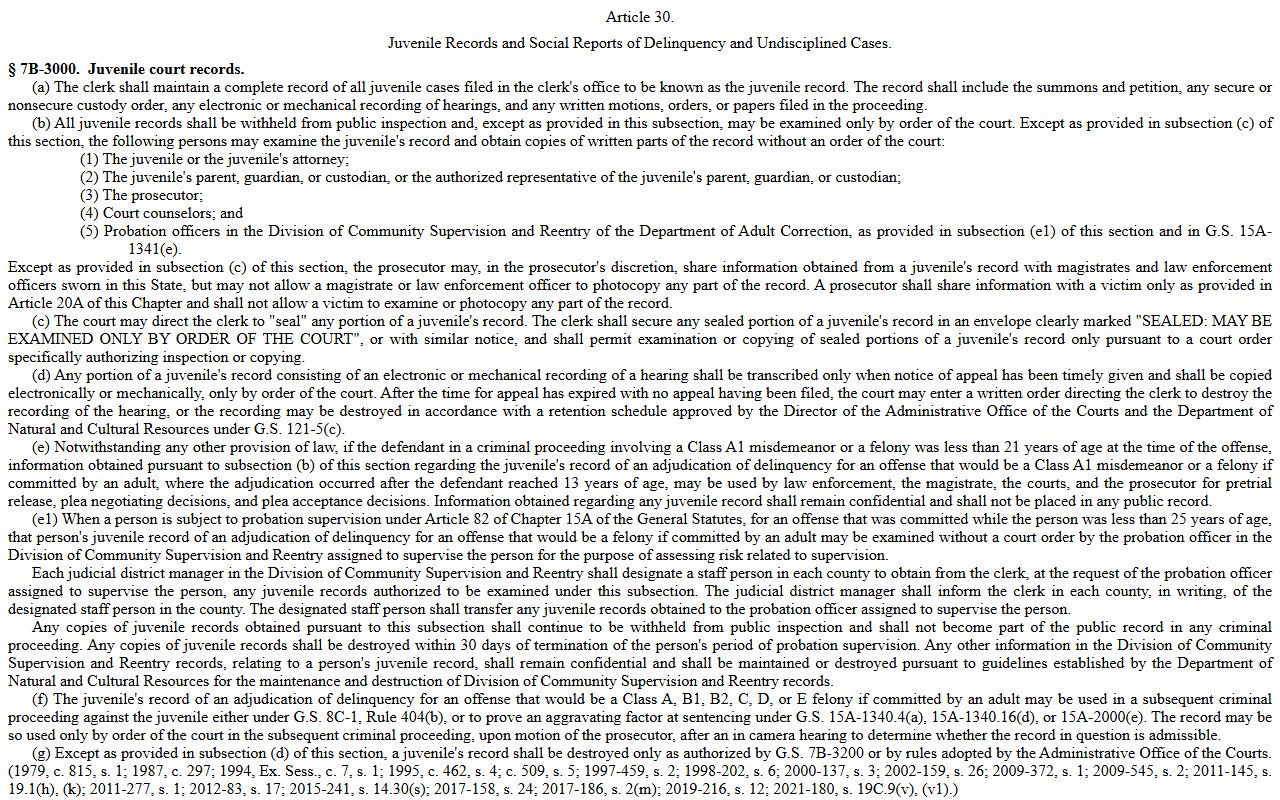
Under G.S. 7B-3000, only listed persons or a court order can open a juvenile file, so these never show on a public arrest page.
Sealed vs. Expunged Records
People use these words as if they mean the same thing. They do not. A sealed record is closed to public view but still exists. An expunged record is removed, sealed, or destroyed and is treated as if it never happened. North Carolina law sets out who may petition and when.
| Sealed | Expunged | |
|---|---|---|
| Visibility | Hidden from the public | Removed or destroyed, treated as never existing |
| Law Enforcement | Limited access remains | Very limited; a confidential state file may remain |
| Eligibility | Set by statute or court order | Set by the specific expunction statute |
Expunction petitions are filed with the Clerk of Superior Court in the county where the person was charged or convicted. For Union County cases, that means the Union County clerk. The general filing fee is $175, but many dismissed, not-guilty, and juvenile expunctions have no fee at all. If a petitioner cannot afford the fee, they may ask to file without paying.
Different outcomes follow different statutes. First-offender and certain underage offenses fall under G.S. 15A-145. The screenshot below is G.S. 15A-145 on the General Assembly site.
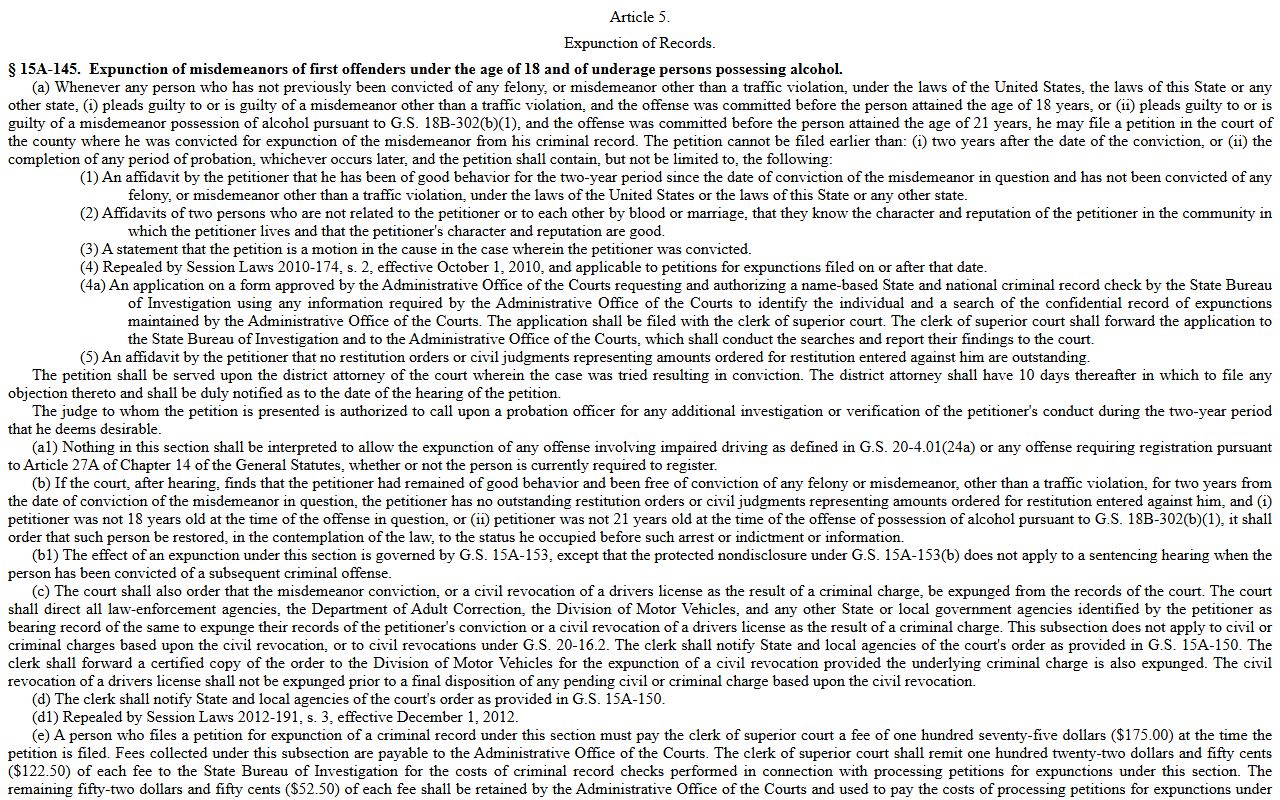
That statute lets eligible first offenders petition in the county of conviction. Nonviolent felony and misdemeanor convictions are handled under a separate law, shown below from G.S. 15A-145.5.
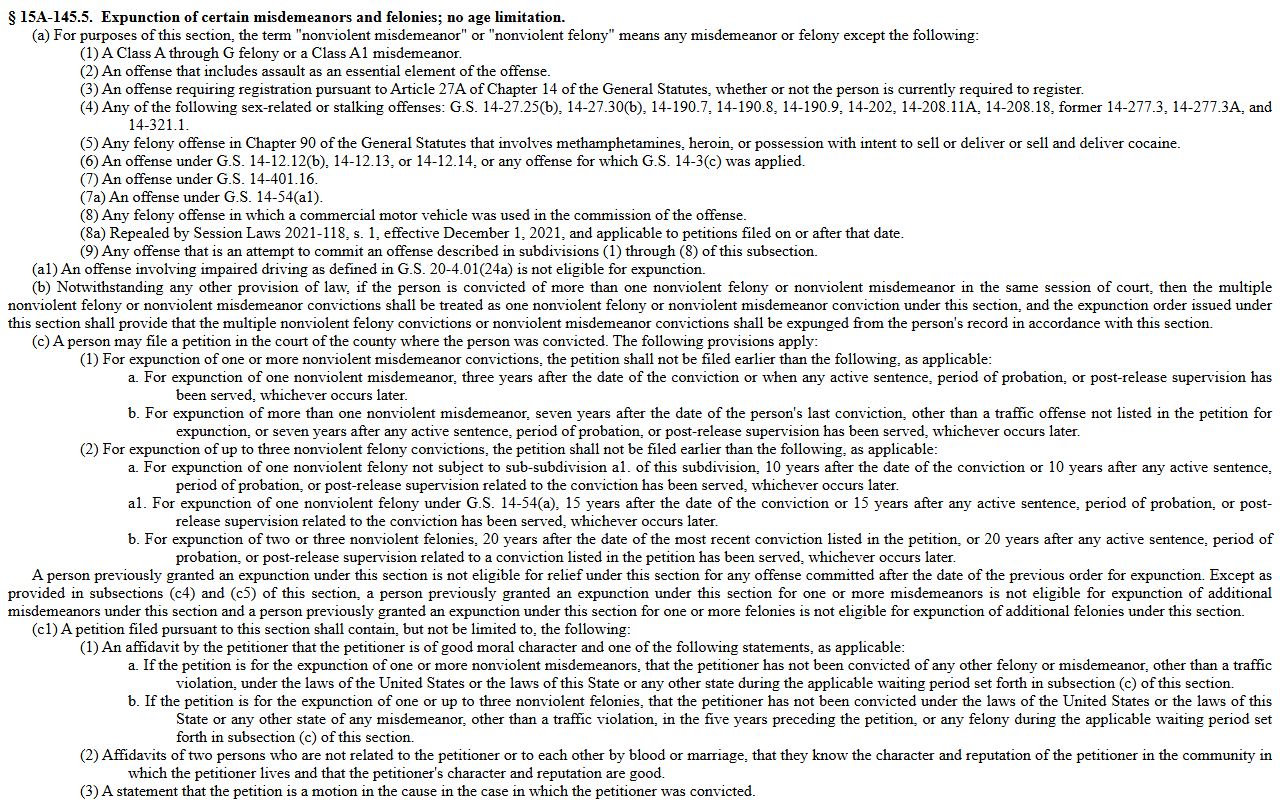
G.S. 15A-145.5 sets waiting periods and exclusions for adult convictions. Dismissed charges and not-guilty findings have their own path, captured below from G.S. 15A-146.
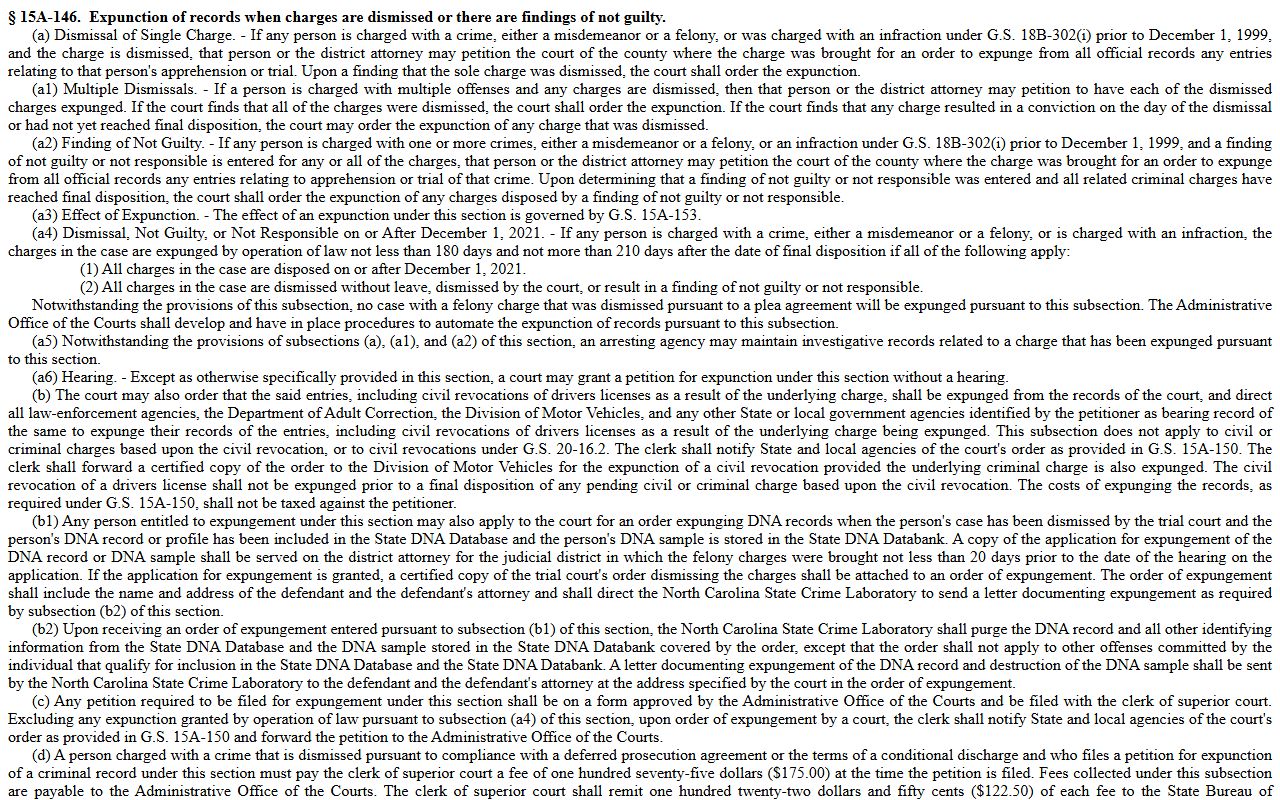
G.S. 15A-146 is the key statute for dismissed cases and not-guilty outcomes, and many of these carry no filing fee. Expunctions can still take several months because of record checks and hearing scheduling.
Full Criminal Court Case History
Arrest data is only the front door. To follow a criminal case from charge to judgment, you need the court file. Those records list the charges, statute cited, pleas, hearings, and the final disposition. They are searched through the state eCourts Portal and held by the Clerk of Superior Court.
That depth lives on a different page. For the Portal walkthrough, the search fields, and the full record field list, see the Union County court records page. For impaired-driving charges, which carry their own DMV and bond steps, the traffic court records page covers DUI and DWI handling.