
What Is a Union County Court Docket
A docket is the court's running list of events in a case. Each line is one event, set in date order. A docket tells you what was filed, what the judge did, and what comes next. It is not the full file. The full file holds the actual motions, orders, and exhibits. The docket is the index that points to them.
Think of the docket as the table of contents and the case file as the book. The docket shows a motion was filed; the file holds the motion itself. In North Carolina, every Union County case carries a docket, whether it sits in Superior Court or District Court.
People also use the word docket to mean a court calendar, the list of cases set for a given session. Both meanings matter here. The case docket follows one matter over time. The calendar docket lists many cases set for one day. The eCourts Portal can surface both.
How to Find Union County Court Dates Online
The official tool for Union County court dockets is the North Carolina eCourts Portal. The state moved all 100 counties onto the Enterprise Justice system, also called Odyssey, by October 13, 2025. Union County joined in October 2024. The Portal is free and public. It lets you search court records, find hearing dates, and pay some matters. The Union County page on the Judicial Branch site links the court date search straight to the Portal.
You can search by party name, case or record number, citation number, or attorney. Pick Union County so statewide results do not crowd the list. The steps below walk through a court date lookup.
- Open the eCourts Portal or start from the Union County Judicial Branch page.
- Choose the court date or hearing search where the Portal offers it.
- Select Union County and enter a party name, case number, or citation number.
- Open the result and read the docket entries for the date, court, and next setting.
Civil and criminal calendars sit on the same system but separate by case type. A criminal calendar lists arraignments, pleas, and trials. A civil calendar lists motions, hearings, and trials in lawsuits. Small claims and family matters keep their own settings under District Court. Superior Court runs sessions for felonies and larger civil cases.
Sample Union County Docket Entry
Each docket line packs several fields into a short row. Once you learn them, a Union County court docket reads fast. The fields below mirror a standard Odyssey public case view. Some columns only show on the detail screen, and confidential parts stay hidden from the public.
| Field | What It Shows |
|---|---|
| Entry Date | The date the filing, hearing, or order was logged. |
| Event Type | Filing, motion, hearing, continuance, order, judgment, or notice. |
| Party / Filer | State, plaintiff, defendant, petitioner, or respondent tied to the entry. |
| Hearing Setting | Date, time, courtroom, session, and sometimes the judicial officer. |
| Disposition / Result | The outcome of the event, such as continued, granted, or denied. |
| Document Link | A view-only or downloadable document where the Portal allows it. |
Not every entry carries a document. Many lines are just events, like a continuance or a notice. Certified copies of any filing still come from the clerk, since the public Portal is not the official certified record.
Courts That Publish Dockets in Union County
North Carolina runs one statewide court system, the General Court of Justice. The trial level splits into two parts, and both keep dockets that flow through the same Portal. Magistrates sit under the District Court division and handle smaller matters. Union County is Superior Court District 30 and District Court District 30.
- Superior Court - felonies, larger civil suits, and some appeals from the lower division.
- District Court - misdemeanors, infractions, traffic, family matters, juvenile cases, and small claims appeals.
- Magistrate - warrants, first appearances, small claims, and certain weddings.
- Clerk of Superior Court - estates, special proceedings, judgments, and many filings.
Juvenile dockets are a special case. Many juvenile hearings are open, but the records are confidential and do not appear in a public search. Expunged matters are sealed too. The lead-in below shows G.S. 15A-151, which governs the confidential file of expunged records.
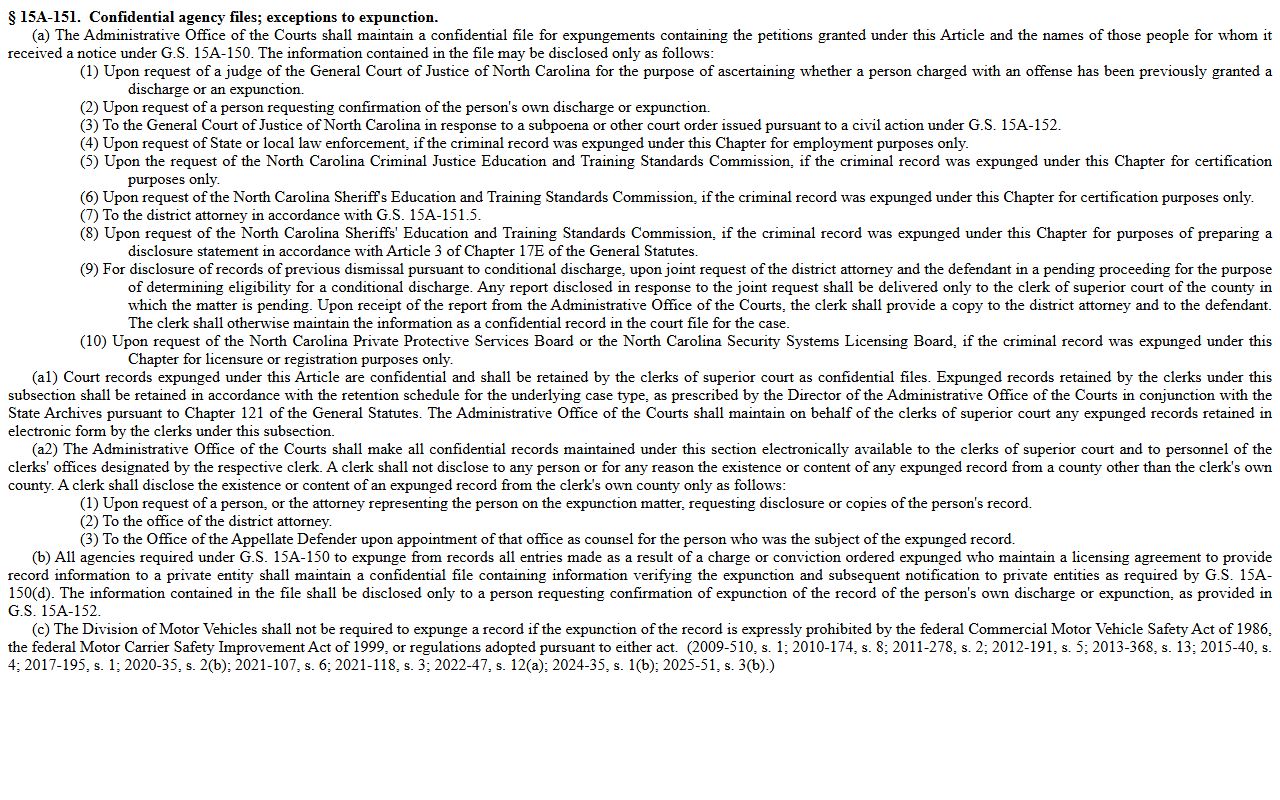
Once a case is expunged, its docket entries are removed from the public view, so a name that once showed may no longer appear.
Docket vs. Full Case Record
A docket and a full case file are not the same thing. The docket lists events. The case file holds the documents those events created. The docket might show that an order was entered on a date. The file holds the order itself. Most people start with the docket and pull documents only when they need them.
| Docket | Full Case Record | |
|---|---|---|
| Format | List of dated entries | Full filed documents |
| Access | Often online and free on the Portal | Some online; certified copies need the clerk |
| Use | Track court dates and case progress | Legal review, evidence, certified proof |
| Detail | Short summary per event | Complete text of motions and orders |
For the deeper field-by-field view of a case file, see the Union County court records page. It breaks down each record field and shows the full search-field table.
How to Read a Union County Docket
Court dockets use shorthand. The terms below cover the words you will meet most often when you read Union County court dockets. Knowing them helps you spot the real status fast and tell a setting from a result.
- Motion
- A request asking the court to enter an order.
- Order
- A judge or clerk's written directive in the case.
- Continuance
- A rescheduling of a hearing to a later date.
- Arraignment
- A criminal setting where charges and the plea are addressed.
- Disposition
- The outcome of a charge or the case.
- Judgment
- A final or enforceable decision that resolves claims or imposes a sentence.
- Capias / Order for Arrest
- Process issued after a failure to appear or other court default.
Watch the disposition line for the real result. Pending means the case is open. Disposed means it closed. "Dismissed with prejudice" cannot be refiled; "without prejudice" can come back. A continuance only moves a date and does not end anything.
Note: A docket entry can lag the live event, so always confirm a court date with the Clerk of Superior Court before you rely on it.
What to Do If You Miss Court in Union County
Missing a court date is serious. In a criminal or traffic case, the judge can issue an order for arrest, also called a capias, and add a failure-to-appear charge. The docket will show the new event. You do not want to ignore it.
Act fast. Call the Clerk of Superior Court to learn your status and any new setting. A lawyer can often file to recall the order or set a new date. The Portal is the quickest way to confirm whether an order for arrest already shows on your docket. For traffic matters, the traffic court records page covers how to handle a ticket. For charges and arrests, see arrest records.
Portal Limits and Clerk Help
The public Portal is useful, but it has limits. It is not the official certified record. A clerk must enter a filing before it shows online, so the docket can run behind the live case. Sealed, expunged, juvenile, adoption, and mental health matters are hidden. The state administrative office is not the keeper of county case files either.
When the online view falls short, the clerk is the answer. The Clerk of Superior Court keeps the official dockets, files, and judgments for Union County. For office details and copy requests, see the Clerk of Superior Court page. For court-by-court structure and the trial divisions, see the District Court page, which also covers Superior Court.