
How to Search Union County Court Records
The main tool for Union County court records is the North Carolina eCourts Portal. The state finished moving all 100 counties onto the Enterprise Justice system, also called Odyssey, by October 13, 2025. Union County went live a year earlier, in the October 2024 group of Piedmont counties. The Portal lets you search by party name, case or record number, citation number, or attorney. It is free and open to the public. You can also reach it through the Union County page on the Judicial Branch site.
Before you start, gather what you know. A full name helps. A case number or citation number helps more. Pick Union County in any county field so your results stay local and clean.
The screenshot below comes from the Judicial Branch Union County landing page, the official starting point for county court links.
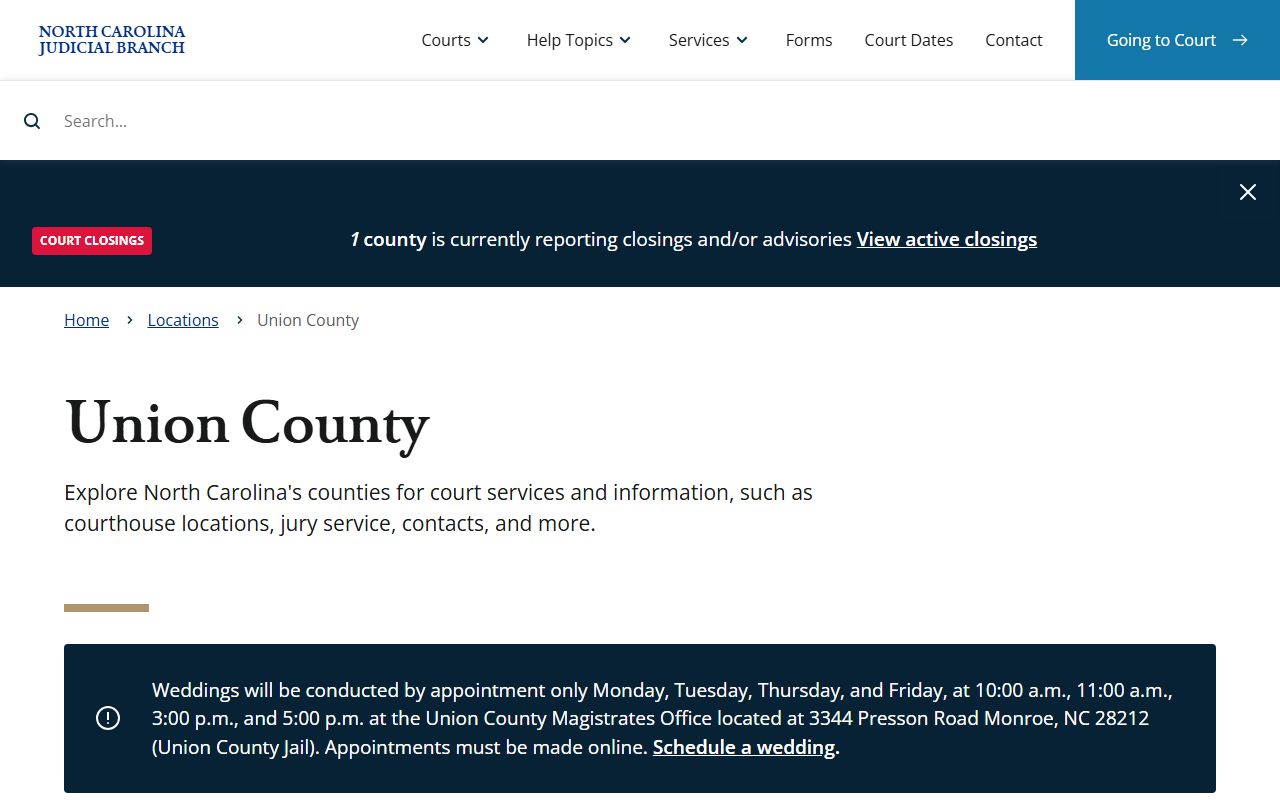
That page links the Portal, court date search, payment information, jury service, and the local contact directory in one place. Use it as your home base for any Union County Court records search.
- Open the eCourts Portal or start from the Union County Judicial Branch page.
- Pick the search type you need: case search, court date, or citation and payment.
- Select Union County so statewide results do not crowd the list.
- Enter a party name, case number, citation number, or attorney name.
- Review the result rows for case number, parties, court type, and status.
- Open a case to read docket entries; request a certified copy from the clerk if you need an official record.
Here is the Portal search screen itself, taken from the North Carolina eCourts Portal.
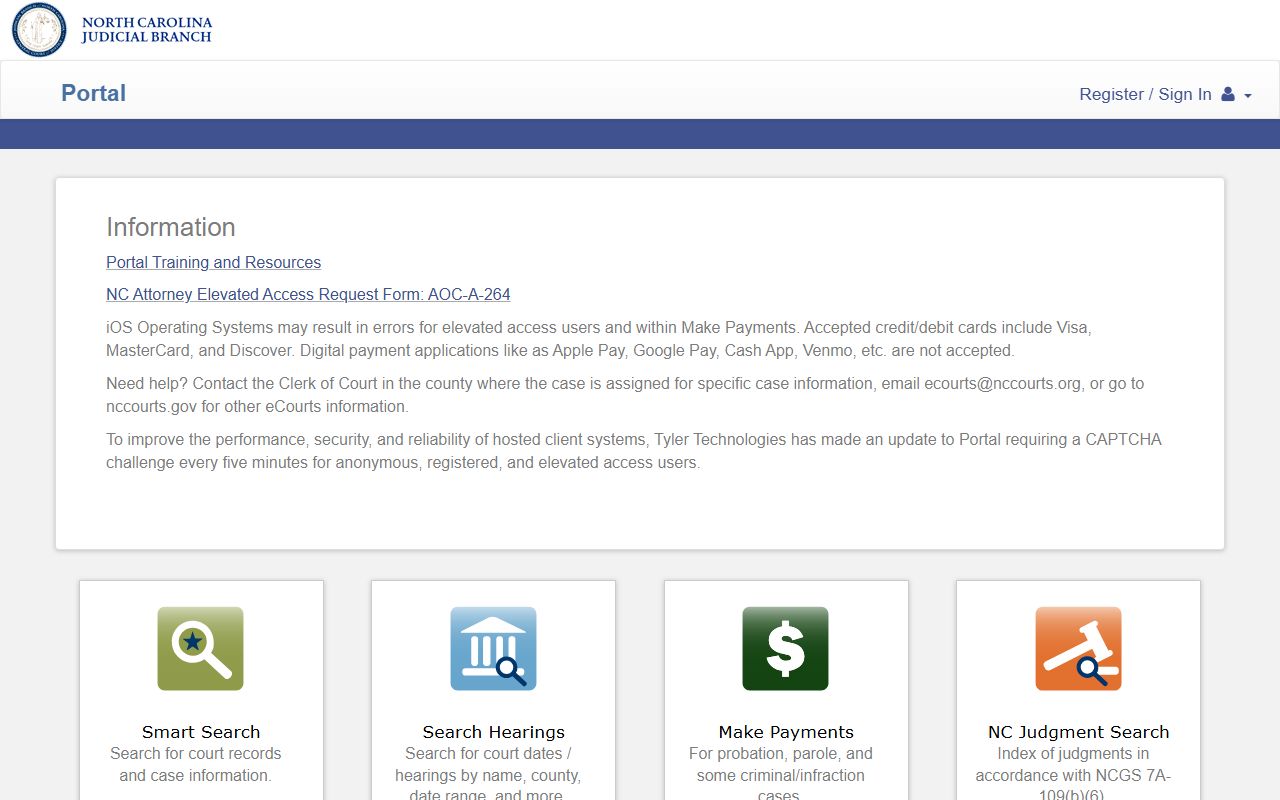
The Portal is the same statewide tool every North Carolina county now uses, so the layout stays the same whether you search Union County or a neighbor.
The Union County Judicial System
North Carolina runs one statewide court system called the General Court of Justice. It splits into appellate courts and trial courts. The trial level has two parts. Superior Court hears felonies, larger civil cases, and some appeals from the lower division. District Court hears misdemeanors, infractions, traffic, family matters, juvenile cases, and small claims. Union County is Superior Court District 30 and District Court District 30. Magistrates handle warrants, first appearances, small claims, and some weddings.
Appeals from Union County trial courts move up to the North Carolina Court of Appeals and, when the law allows, the North Carolina Supreme Court. Federal matters go to the U.S. District Court for the Western District of North Carolina, not the county clerk.
Case flow: District Court › Superior Court › Court of Appeals › Supreme Court
| Court | Jurisdiction | Case Types |
|---|---|---|
| Superior Court | Higher trial court, District 30 | Felonies, larger civil suits, appeals from District Court |
| District Court | Lower trial court, District 30 | Misdemeanors, traffic, family, juvenile, small claims |
| Magistrate | Judicial officer | Warrants, first appearances, small claims, weddings |
| Clerk of Superior Court | County records custodian | Estates, special proceedings, judgments, filings |
For a deeper look at the trial level, see the Union County District Court page, which also covers Superior Court.
Types of Court Records Available in Union County
The clerk keeps many kinds of court files. Some are open to anyone. Some are sealed by law. Most adult case records can be searched, read, and copied unless a statute or judge says otherwise.
Different courts make different records. District Court produces most traffic and small-claims files. Superior Court produces felony and large civil files. The clerk holds estates and special proceedings.
- Criminal records - warrants, charges, pleas, judgments, and sentences from District and Superior Court.
- Civil records - complaints, answers, motions, judgments, and liens.
- Family records - divorce, custody, child support, and protective orders, with limits on sensitive parts.
- Probate and estate records - wills, letters, inventories, and accountings kept by the clerk.
- Traffic records - citations, fines, and dispositions, separate from the DMV driver record.
What Union County Court Records Show
A court record is built from set fields. Once you know them, a docket is easy to read. The Portal shows most of these for public cases, while sealed parts stay hidden. The list below mirrors a standard Odyssey public case view for Union County.
| Field | What It Shows |
|---|---|
| Case Number | The unique court file number in Odyssey format. |
| Filing Date | When the case opened or the filing was accepted. |
| Parties | State, plaintiff, defendant, petitioner, or respondent and their roles. |
| Charges / Cause | Offense or claim, statute cited, and degree or class. |
| Disposition | Outcome such as pending, dismissed, convicted, or judgment entered. |
| Sentence / Judgment | The court's final order, fines, costs, or terms. |
The Union County court records page breaks each field down in more detail and shows the full search-field table.
Public Access Laws for Union County Court Records
North Carolina law leans toward open records. The state Public Records Act treats most government documents as public, and court files have their own rules on top of that. Clerk records stay open during regular office hours unless a statute blocks them. The state online-services page is a good map of what the Judicial Branch offers the public.
The page below is the Judicial Branch online services page, which links Portal, eFiling, public record requests, and more.
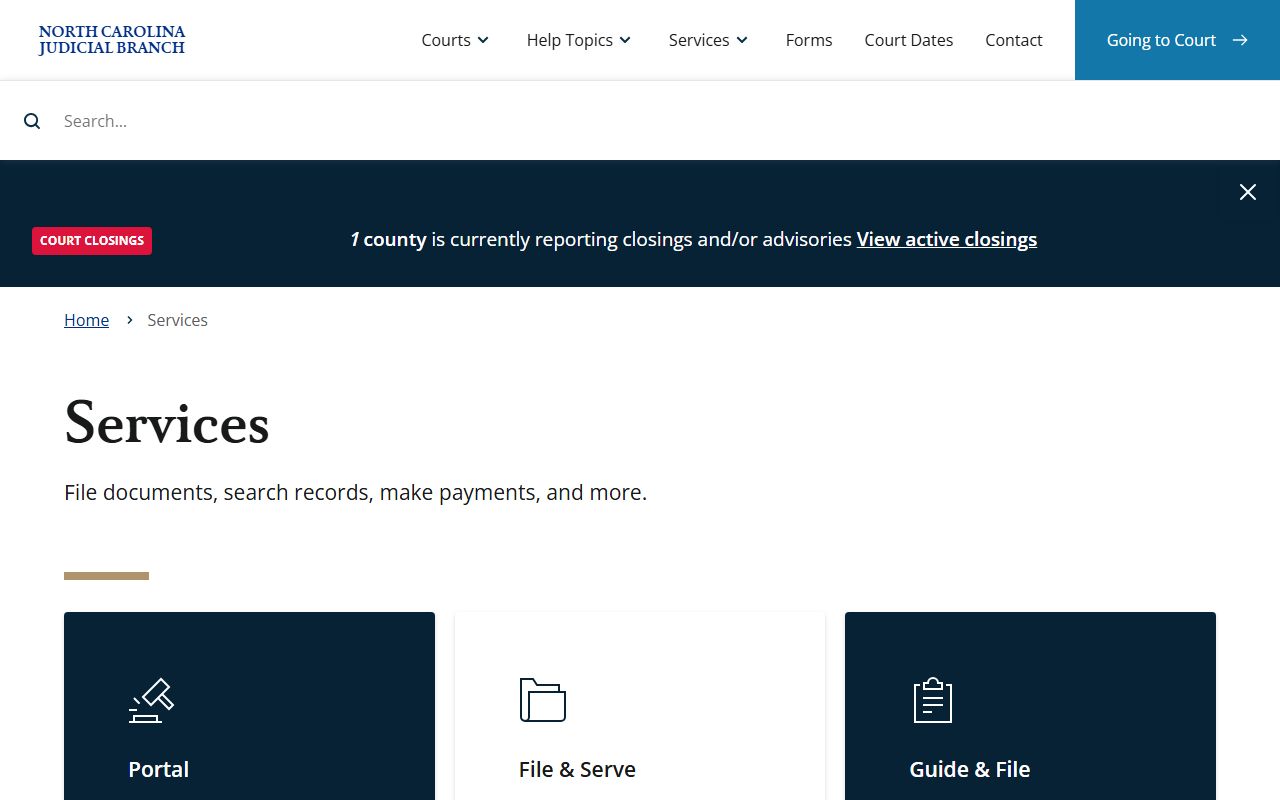
Note that the state administrative office is not the keeper of county case files, so a county records request goes to the Union County clerk, not the state.
Key Statutes:
N.C. G.S. § 132-1 - Defines public records broadly across state and county government.
N.C. G.S. § 7A-109 - Keeps clerk court records open during office hours except where the law prohibits it.
N.C. G.S. § 7B-3000 - Withholds juvenile court records from public inspection.
Records That Are Restricted or Confidential
Not every file is open. Some are closed to protect children, victims, or people whose cases ended in their favor. Juvenile delinquency records are confidential, even though many juvenile hearings are open. Adoption files, mental health commitments, and abuse or neglect files are restricted by statute. Expunged records are removed or sealed and will not show up in a normal search.
To view a sealed record, you usually must be an authorized party or get a court order. The petition goes to the Clerk of Superior Court in the county where the case was filed. For Union County cases, that means the Union County clerk. Sensitive details like Social Security numbers and bank account numbers are redacted even on otherwise public files.
Specialty Courts in Union County
North Carolina runs problem-solving courts called recovery courts. They mix treatment, drug testing, and close judicial review with rewards and sanctions. The Union County Judicial Branch page lists DWI Treatment Court as a related program. It is aimed at repeat or high-risk impaired-driving defendants who need structure and supervision.
These courts are not open to everyone. A judge must order placement, and local space depends on funding and case type. Anyone who thinks a recovery court fits their situation should ask their attorney or the court. Placement is never automatic.
Union County Sheriff and Jail
The Union County Sheriff's Office runs the county jail and posts public records online. Sheriff Eddie Cathey was sworn in on December 1, 2002 and was recognized in 2024 as the county's first six-term elected sheriff. The office is one of the largest full-service law enforcement agencies in the state. The jail and sheriff complex sit on Presson Road, away from the downtown courthouse.
The sheriff's online roster, daily bulletin, and recent arrests pages are useful starting points. For the full roster, see Union County inmate records. For active warrants and most-wanted notes, see warrant records. To track a release, the released inmates page explains state and federal tools.
Marriage, Divorce, and Probate Records
Marriage and vital records do not sit with the court clerk. The county Register of Deeds at 500 North Main Street issues marriage licenses and certified copies. Divorce, though, is a court case filed with the Clerk of Superior Court. Probate and estate files also go through the clerk, since North Carolina has no separate probate court. See marriage and divorce records and probate records for full steps.
- Testator
- A person who dies leaving a valid will.
- Executor
- The person named in a will to settle the estate.
- Administrator
- The person the clerk appoints when there is no will.
- Guardian
- A person the clerk appoints to act for a minor or an adult who cannot act alone.
Union County Court Records Fees
Fees depend on what you ask for and who keeps it. A certified single-county criminal record search runs through the Clerk of Superior Court with Form AOC-CR-314 and a set fee. Vital record copies come from the Register of Deeds at a different rate. The table below pulls the figures confirmed by official Union County and Judicial Branch pages.
| Item | Amount |
|---|---|
| Certified single-county criminal record search (AOC-CR-314) | $25 |
| Certified birth, death, or marriage copy (Register of Deeds) | $10 each |
| Uncertified birth, death, or marriage copy | $1 each |
| General expunction filing fee | $175 (many dismissed or juvenile types are free) |
Mailed payments for the criminal record search must be money order or certified check. In person, the clerk also takes credit card, cash, money order, or certified check.
How to Interpret Union County Court Records
Court files use shorthand. A charge is not the same as a conviction. A charge is what the State says you did. A conviction is a guilty plea or a finding of guilt the court enters. A dismissal means the case ended without a conviction. "Dismissed with prejudice" means it cannot be refiled. "Without prejudice" means it can come back.
Watch the disposition line for the real outcome. Pending means the case is open. Disposed means it closed. Always read the judgment for fines, costs, or terms before you rely on a record.
Accuracy and Record Limitations
Online records lag real life. A clerk must enter a filing before it shows in the Portal, and that can take time. The public Portal is also not the official certified record. For anything that matters in court, in a job, or in a legal filing, confirm the file with the clerk and get a certified copy.
Note: Always confirm names, charges, and outcomes with the Clerk of Superior Court before you rely on a record pulled from the online Portal.
History of Union County Courts
Union County was formed in 1842, and the Register of Deeds has kept county records since that year. A historic courthouse still stands in downtown Monroe, but active court business now runs from the Judicial Center. The biggest recent change is digital. Union County joined eCourts in October 2024, and the state added public eCourts kiosks with scanners, printers, and payment tools in June 2025.
The eCourts move matters for records access because filings, case management, and the public Portal all run on one statewide system now. The image below is the North Carolina eCourts overview page.
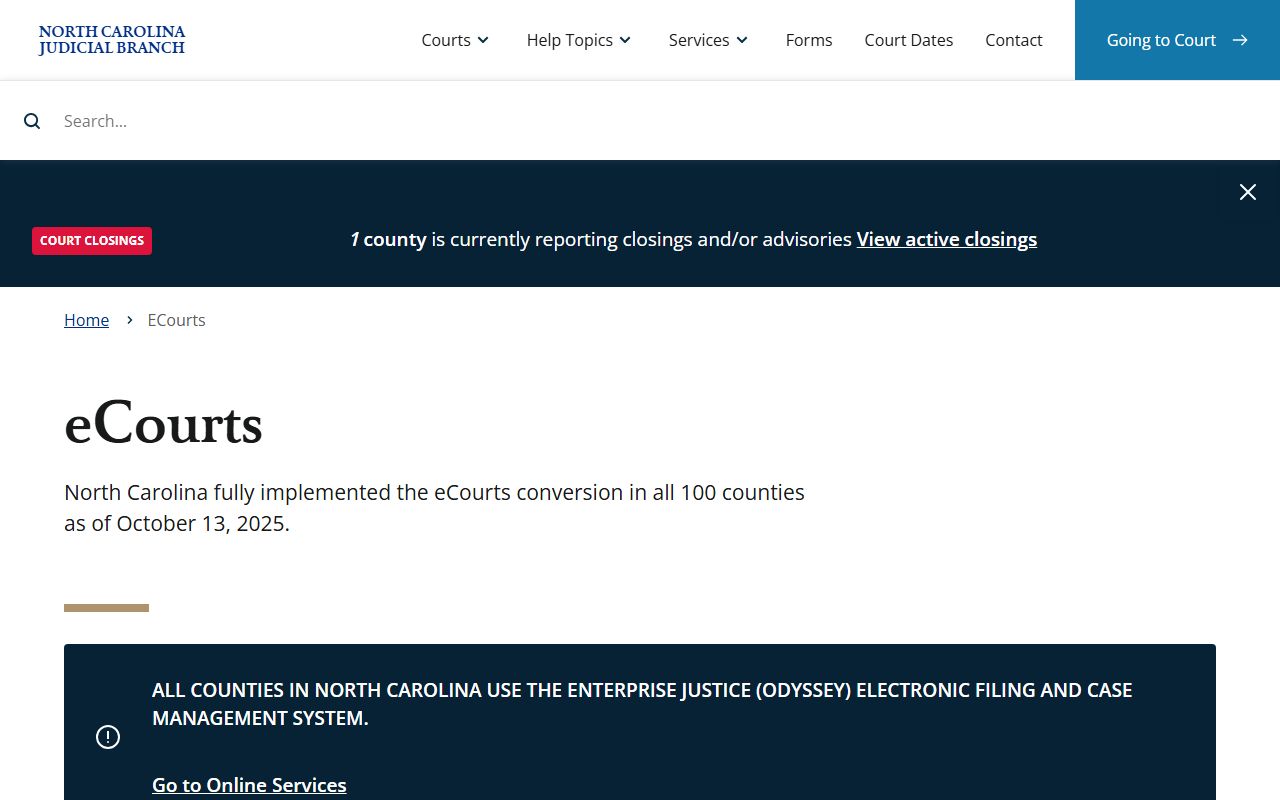
That single system is why a Union County search looks the same as a search in any other North Carolina county today.
Union County Courthouse Contact Information
The main court facility is the Union County Judicial Center in downtown Monroe. The Register of Deeds and several county offices sit one block north. Knowing the right address keeps you from driving to the wrong building. The contact directory below lists the clerk, judges, district attorney, and magistrates.
This screenshot is the Union County court contact directory.
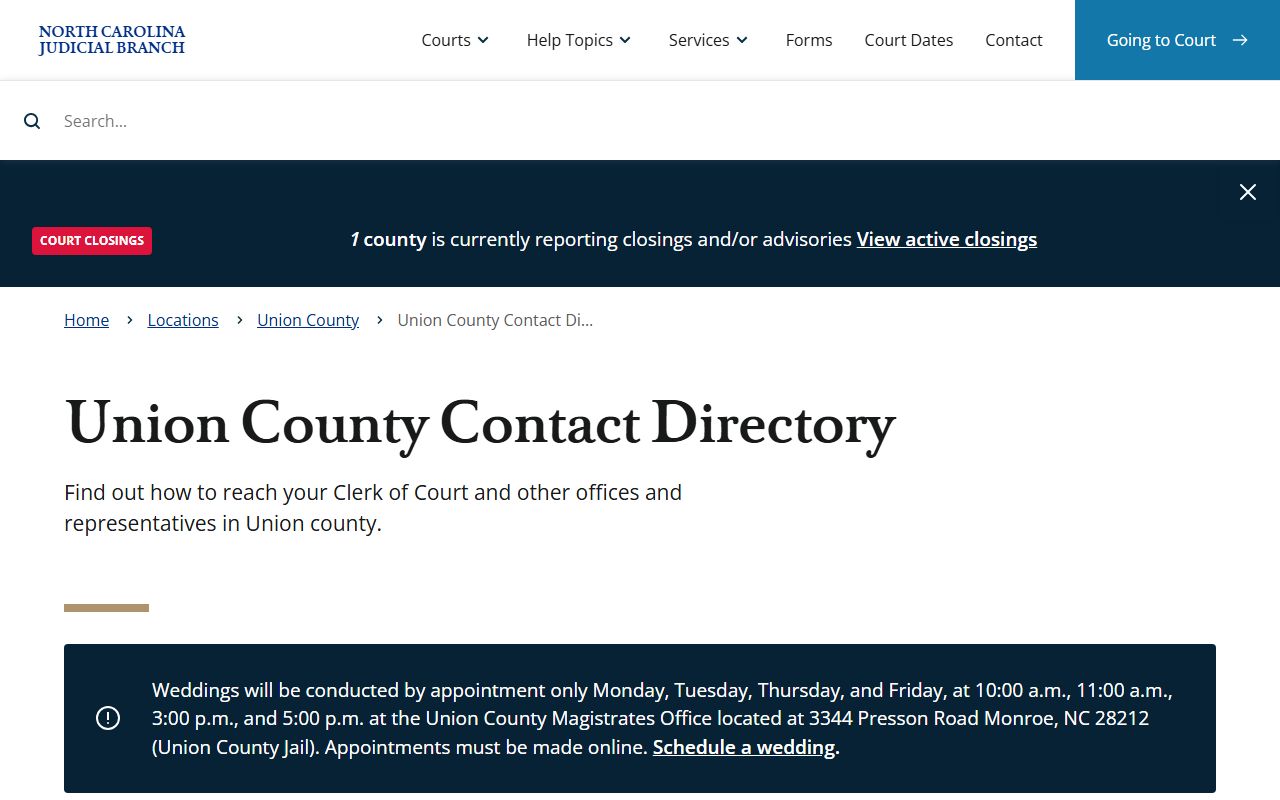
Use the directory to find the exact office before you call, since court and jail functions sit in different buildings.
The court building itself is shown on the Union County Judicial Center page.
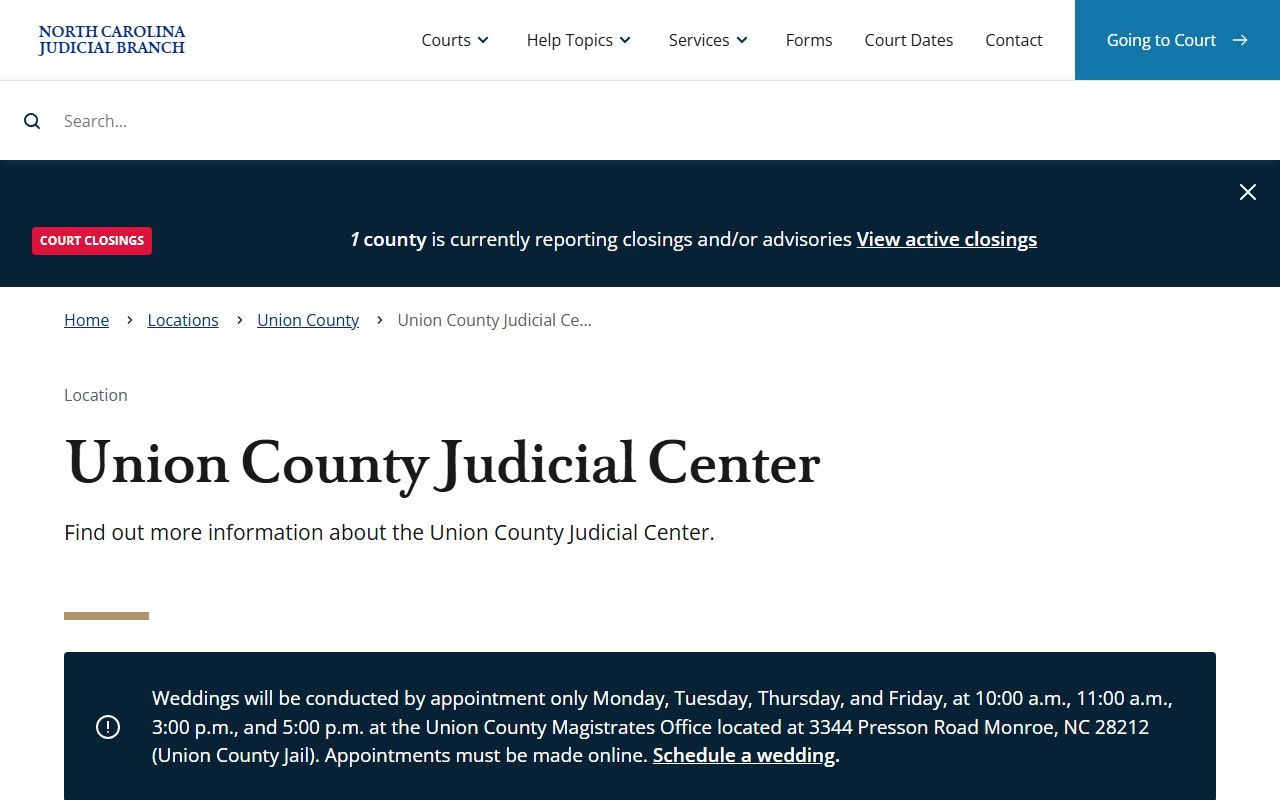
That center on North Main Street holds both Superior and District Court for District 30, along with the Clerk of Superior Court.
Union County Register of Deeds
500 North Main Street, Suite 258
Monroe, NC 28112
704-283-3843
Union County Sheriff's Office
3370 Presson Road
Monroe, NC 28112
704-283-3789
Self-Help and Legal Aid in Union County
Court staff can hand you forms and explain process, but they cannot give legal advice. For that, the state offers several free or low-cost paths. Legal Aid of North Carolina helps eligible low-income residents with civil matters and some expunctions. The Bar Association runs a find-a-lawyer service. Indigent Defense Services covers appointed counsel in criminal cases.
The statewide forms library is a strong starting point for pro se filers. The screenshot below shows the Union County local rules and forms page.
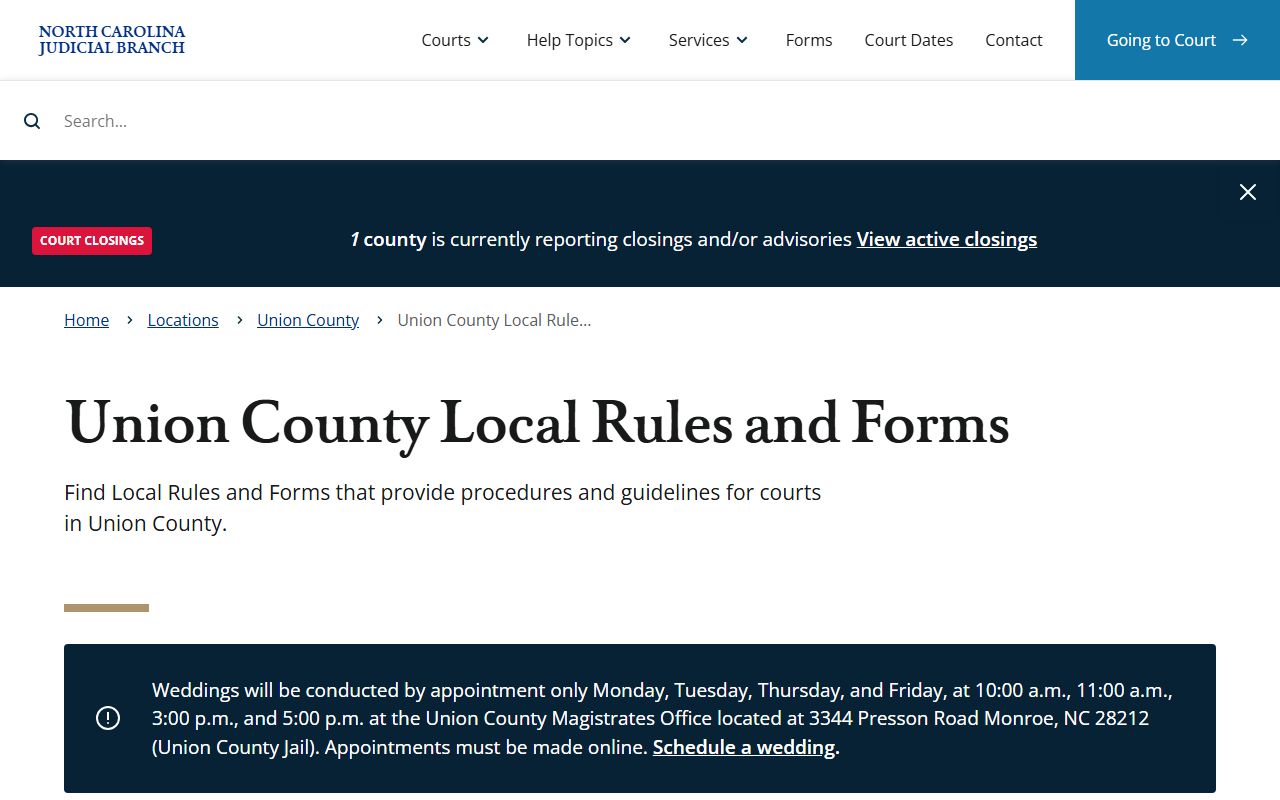
Local rules and forms here are county-specific, so check them before filing anything in Union County District or Superior Court.
Frequently Asked Questions
How do I search Union County court records online?
Use the North Carolina eCourts Portal and choose Union County where a county filter shows. Search by party name, case or record number, citation number, or attorney. The Portal works well for case details, hearing dates, and payments. Certified copies and official criminal background checks still come from the Clerk of Superior Court, not the Portal.
Are Union County court records public?
Many adult civil, criminal, traffic, estate, and judgment records are public unless a statute or court order closes them. G.S. 7A-109 keeps clerk records open during office hours, except where the law prohibits access. Juvenile, adoption, mental health, sealed, and expunged records are not open to the public.
Where is the Union County courthouse?
The main facility is the Union County Judicial Center at 400 North Main Street, Monroe, NC 28112. The Register of Deeds is nearby at 500 North Main Street. The sheriff and jail sit on Presson Road, so confirm which office you need before you drive.
More answers are on the Union County Court records FAQ page.